Page 3 of 4
Re: Analyzing Alcohol 120% DPM
Posted: Sun Mar 09, 2025 12:14 pm
by reentrant
Which 4 byte enumeration?
Re: Analyzing Alcohol 120% DPM
Posted: Sun Mar 09, 2025 3:57 pm
by Nemok
reentrant wrote:Which 4 byte enumeration?
The DPM sample itself I guess.
Code: Select all
DPM sample     value     timing

1C 05 00 00    1308
38 0A 00 00    2616      1308
53 0F 00 00    3923      1307
6E 14 00 00    5230      1307
88 19 00 00    6536      1306
A2 1E 00 00    7842      1306
BB 23 00 00    9147      1305
D4 28 00 00    10452     1305
ED 2D 00 00    11757     1305
05 33 00 00    13061     1304
1D 38 00 00    14365     1304
sarami,
If I rely on the values you were getting in 2020, the sampling seems to be wrong in the first place :
Code: Select all
value ?        timing ?

154.500100
154.566300     0,0662
154.758100     0,1918
154.850500     0,0924
154.853000     0,0025
155.114800     0,2618
155.013000     −0,1018
155.249500     0,2365
155.350000     0,1005
155.493100     0,1431
155.512100     0,019
155.672400     0,1603
155.690200     0,0178
155.774200     0,084
156.011200     0,237
156.051600     0,0404
156.179200     0,1276
156.326700     0,1475
156.385200     0,0585
156.486800     0,1016
These timings look inconsistent. I would be curious to see if they also vary across multiple dumps though (same disc, same drive, same settings).
Re: Analyzing Alcohol 120% DPM
Posted: Mon Mar 10, 2025 10:40 am
by sarami
Nemok wrote:The DPM sample itself I guess.
Ah, yes. I don't know yet how A120% outputs these values.
Nemok wrote:These timings look inconsistent.
Yes. It's a research phase and useless.
Re: Analyzing Alcohol 120% DPM
Posted: Tue Mar 11, 2025 1:16 am
by Nemok
About reverse engineering, I'm not sure that the alcohol application is the best candidate to start from. I've only recently discovered that the old .bwa file format used by Blindwrite back in 2002 was in fact storing DPM information the exact same way than the very latest Alcohol 120% version released in 2023.
The thing is that those .bwa files were created by a much smaller dedicated stand-alone program called BWA builder. Since smaller probably also means it's simpler, it might be more interesting to analyze it with Bus Hound, or even to decompile it.
Re: Analyzing Alcohol 120% DPM
Posted: Tue Mar 11, 2025 6:06 am
by reentrant
This is used by BWA Builder in the driver:
https://learn.microsoft.com/en-us/windo … ncecounter
ULONGLONG performanceFrequency = 0;
ULONGLONG performanceCounter = KeQueryPerformanceCounter(&performanceFrequency);
ULONGLONG ticksMicroSeconds = 1000000 * performanceCounter / performanceFrequency;
I guess on APP side (before DeviceIoControl is made to ASPI driver) the same value is calculated (QueryPerformanceCounter / QueryPerformanceFrequency) and substracted after the call.
There's no driver in DIC but I think it can be emulated purely in user mode just by (QueryPerformanceCounter / QueryPerformanceFrequency) and slow read speed.
Re: Analyzing Alcohol 120% DPM
Posted: Tue Mar 11, 2025 11:52 am
by sarami
reentrant wrote:ULONGLONG performanceFrequency = 0;
ULONGLONG performanceCounter = KeQueryPerformanceCounter(&performanceFrequency);
ULONGLONG ticksMicroSeconds = 1000000 * performanceCounter / performanceFrequency;
I implemented the following in a test version(
/viewtopic.php?p=41294#p41294).
Code: Select all
LARGE_INTEGER freq = {}, current = {}, end = {};
QueryPerformanceFrequency(&freq);
double time = 0;
QueryPerformanceCounter(¤t);
(Read the CD multiple times)
QueryPerformanceCounter(&end);
time = static_cast<double>(end.QuadPart - current.QuadPart) * 1000 / static_cast<double>(freq.QuadPart);
Re: Analyzing Alcohol 120% DPM
Posted: Fri Mar 14, 2025 10:16 pm
by Nemok
Wish I could help you, but for now that's beyond my understanding.
All I know is that BWA builder had an alleged precision of about 6 µs.
Re: Analyzing Alcohol 120% DPM
Posted: Fri Apr 04, 2025 9:06 am
by Nemok
I did a bit of testing with different time stamp functions. It seems that after simply iterating a printf in a for loop, clock(), QueryPerformanceCounter() in Windows, and clock_gettime() in Linux give extremely close results when CLOCK_PROCESS_CPUTIME_ID is used.
If that behavior is consistent in any situation, which needs to be checked, I find it even harder to understand how one would achieve the task of measuring DPM with these functions, unless the I/O latency is deduced, because they try to assess the same thing, that is the CPU time spent on a process, while the time NOT spent by the CPU is required for DPM (as I see it).
I wonder if calculating the difference between clock_gettime(CLOCK_MONOTONIC) and clock_gettime(CLOCK_PROCESS_CPUTIME_ID) is enough to approximate the drive's latency variations.
Re: Analyzing Alcohol 120% DPM
Posted: Tue Apr 15, 2025 11:45 am
by Nemok
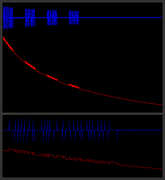
I have added a graphical representation of the timings in DPM SCN. Simply drag and drop a mds file on 'scan' and press Escape key to close the window. A corresponding .bmp file will be created, along with a .log file that contains the stats and all DPM values in a human readable format.
Linux :
https://github.com/jonblau/dpmscn/relea … _64.tar.gz
Windows :
https://github.com/jonblau/dpmscn/relea … x86_64.zip
For example, a SecuROM 7 disc (
https://redump.info/disc/105429/) :
- timings in red
- timing variations in blue
Re: Analyzing Alcohol 120% DPM
Posted: Tue Apr 15, 2025 4:26 pm
by reentrant
Looks nice, could you write something more?